
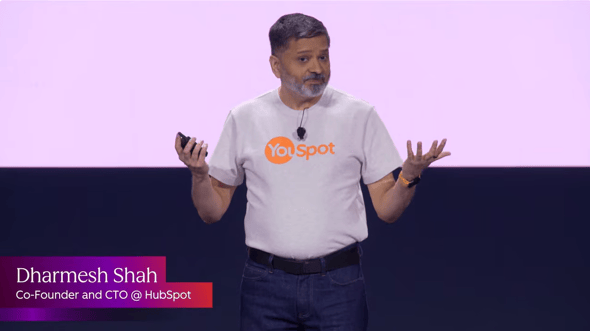
At UNBOUND 2026, Dharmesh Shah, co-founder and CTO of HubSpot, used his time on stage to make an important announcement: YouSpot is now live. And why are we talking about this? This product signals where HubSpot is headed and is worth the attention of any company operating within the ecosystem.
What Is YouSpot?
HubSpot describes YouSpot as "the first AI-native Solo CRM." It's a project from HubSpot Next, the company's innovation arm that tests new products, new technologies, and new markets (in this case, all three at once).
The most important definition came from a turn of phrase that Dharmesh made a point of highlighting:
"This isn't a CRM with AI inside. It's an AI app - an AI harness - with a CRM inside."
In practice, this means that YouSpot behaves like ChatGPT or Claude: you interact through conversation, it supports the latest models and lets you switch between them, but with deep knowledge of CRM, data, and business relationship workflows already built in.
Who it's for: the audience HubSpot wasn't yet serving
HubSpot's agent platform serves companies with 2 to 2,000 employees, which today totals 300,000 customers. YouSpot was created to fill the gap below that: the solopreneur, the one-person business.
HubSpot isn't treating this as a niche market. The numbers Dharmesh shared on stage:
-
5.6 million new businesses will be launched in the U.S. by 2025, a historic record in and of itself.
-
4.3 million had already been launched in 2026 as of the time of the presentation, with projections indicating the record will be broken again this year.
-
85% to 86% of new businesses formed today are one-person companies, with no plans to hire in the first two years.
-
The number of solopreneurs generating more than $1 million in revenue doubled between 2023 and 2025; those exceeding $10 million tripled during the same period.
The argument is straightforward: those who operate alone are, today, trying to be their own CRM, keeping track in their heads of email history, social media posts, a new lead's ICP fit, and follow-ups they can't forget. YouSpot exists to take that off their minds.
How it works in practice: the "second brain"
The core of the product is what Dharmesh calls the "second brain": an interconnected database (a "context graph," in technical jargon) that centralizes people, projects, documents, and posts, fed by the accounts you connect: LinkedIn, email, and social media.
The use case he describes is simple and is, in fact, the very use case that inspired the product: Dharmesh built YouSpot to manage his own professional relationships:
-
Every day, YouSpot sends a summary email with what's been added to the "second brain": relevant comments on social media, new companies that might interest you, and opportunities worth checking out.
-
The user replies to this email to correct or confirm: "this isn't a good fit," "this isn't my field."
-
That response feeds back into the "second brain" and refines the next summary.
It's a compound value loop: each interaction makes the system more accurate, and the value grows over time rather than being fixed from day one.
The product is already available and free to try at youspot.com; signing up via email includes a sort of "personal instruction manual" (who you are, what you do, how you work) so the Second Brain starts off calibrated.
Why This Matters Beyond the Product Itself
The announcement of YouSpot was the practical application of a framework that Dharmesh spent the first half of his presentation building, and which helps explain why HubSpot is investing in this direction.
The central thesis is: AI models depreciate (today's model is worth less when the next one comes out), but context gains value. The data accumulated in a CRM becomes more useful with each new model generation that emerges. Companies and individuals who achieve better results with AI don't have access to different models than anyone else; they have a better "harness" (the layer of code that runs between the model and the user) and more accumulated context.
Breeze, HubSpot's own harness for the enterprise/mid-market, follows this logic. YouSpot is the same strategy applied to a new audience: the individual professional who, until now, did not have an AI harness built specifically for business relationships.
What this means for those using HubSpot today
For agencies, consultancies, and marketing ops teams already operating within the HubSpot ecosystem, YouSpot isn't a product to adopt tomorrow, but rather a sign of the direction things are heading:
- HubSpot is treating accumulated context (CRM data, interaction history) as the asset that truly differentiates AI results, rather than the model chosen. This reinforces the importance of keeping the CRM clean, structured, and up-to-date: it is this data that will be combined with future models.
- The company is testing this harness with an extremely small audience (just one person) because that's where the feedback loop is fastest to validate, but the logic of "a harness with domain context + guardrails" is likely to appear in other layers of the main product.
- It's worth viewing YouSpot as a testing ground: what works here (the daily email as a feedback interface, the "second brain" as a data structure) is a natural candidate to appear, in an adapted form, on the main platform.
It's not a product for migrating customers today. It's for the teams that operate the platform to keep on their radar as a reference for where HubSpot's interface and data logic are headed.